TENSION
Shifting EO from reactive monitoring to proactive prediction
Climate change, rapidly rising global temperatures, and the increasing frequency of severe heatwaves pose an unprecedented threat to terrestrial ecosystems. Across the globe, forests and agricultural systems are facing immense stress, threatening to turn vital carbon sinks into sources of greenhouse gases. But how do we know an ecosystem is dying when it still looks completely green from the outside? Our vision pushes the boundaries of modern Earth Observation, shifting the paradigm from passively monitoring damage to proactively predicting its onset before it is too late.
The State of the Art: Seeing Only the Aftermath
Current satellite systems and global climate models do an extraordinary job of monitoring the Earth's surface using a combination of optical and microwave (radar) sensors. However, operational stress detection still suffers from a fundamental bottleneck. Optical monitoring relies primarily on late-stage symptoms like chlorophyll depletion, canopy browning, or the physical shedding of leaves. By the time optical sensors observe a forest turning brown, it is physiologically too late—the structural degradation has already occurred, and the plant is irreversibly damaged. On the other hand, while microwave and radar sensors can penetrate the canopy to estimate overall water content, isolating the actual pre-visual hydraulic stress from mere changes in physical biomass remains highly complex without a direct mechanistic link to plant physiology. Consequently, without bridging this gap, today's remote sensing technology often acts as a forensic tool, rather than a critical early diagnosis.
The Challenge: Hidden Thirst and the Trans-Scalar Gap
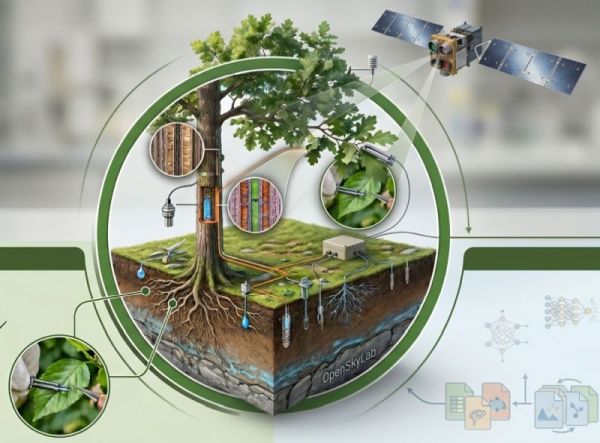
The real cause of rapid vegetation mortality during an extreme drought is not the loss of leaf color. The true, invisible struggle for survival happens deep inside the plant's vascular system. When soil dries out and temperatures spike, the tension inside the plant's water-transporting tissues becomes too great. This leads to cavitation, i.e. the water column snaps, filling with air bubbles. The plant loses its ability to transport water from the roots to the leaves, experiencing what is essentially a hydraulic failure. And the scientific community faces a massive trans-scalar bottleneck in detecting this phenomenon. Using advanced ground sensors, we can accurately measure the hydraulic stress and heartbeat of a single tree. From orbit, we can image entire continents daily. However, we cannot easily bridge these two distinct worlds. Satellites cannot see inside plant veins, and localized sensor data cannot be simply stretched across entire regions. Bridging this gap is one of ours core missions.
Our Solution: From Monitoring to Mechanistic Prediction
Our project overcomes this disconnect by shifting the focus entirely. Instead of waiting for visual symptoms of canopy damage, we are building a comprehensive framework capable of capturing, isolating, and modeling pre-visual stress. To bridge this trans-scalar gap, TENSION employs an integrated approach that merges continuous in-situ monitoring, targeted remote sensing, and advanced artificial intelligence. We establish a vital ground-truth using implantable micro-sensors that measure internal sap flow and hydraulic pressure. When a heatwave triggers, we deploy drones equipped with multi-sensor payloads to isolate invisible pre-visual stress signals. Finally, this precise spatial data is assimilated into an AI-driven, mechanistic Digital Twin of the ecosystem. By anchoring machine learning in physical and biological laws, this virtual replica decodes hidden stress signals to predict the exact threshold of imminent hydraulic collapse.
Impact & A New Era of Early Warning
The result of our vision is the creation of a robust, trans-scalar early-warning framework. By combining the intimate, internal view of a plant's stem with the broad perspective of drones and upscaled satellite data, we aim to generate dynamic vulnerability maps. These maps will do what satellites currently cannot - identify critically threatened regional hotspots weeks before irreversible structural degradation occurs. It provides the crucial lead time needed to implement targeted interventions, optimise smart irrigation, or prepare for yield losses, fundamentally enhancing our ability to protect ecosystems and ensure food security in an increasingly volatile climate.